
Direct answer
Cognitive-liberty resilience is the capacity to keep thinking, reading, searching, speaking, remembering, and correcting error without requiring permission from a centralized observer. The strongest design combines a human-rights floor, anonymous or pseudonymous access, data minimization, end-to-end encryption, local computation, interoperable networks, independent journalism and education, distributed archives, transparent AI and search governance, due process, and hard limits on emergency power.
Six layers that must reinforce one another.
A paper right can be defeated by a technical chokepoint. A private protocol can be defeated by identity law, payment exclusion, device compromise, or archival erasure. Resilience comes from overlap.
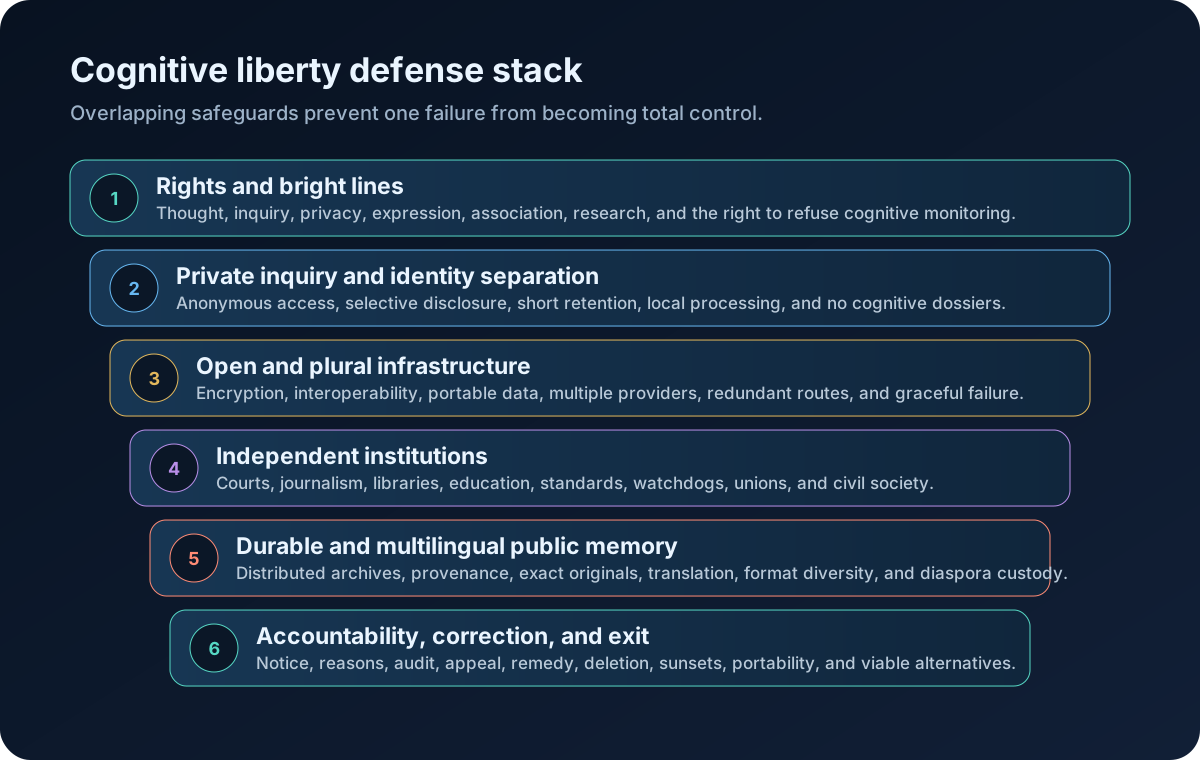
Rights and bright lines
Protect freedom of thought, receipt of information, privacy, association, expression, research, and the right to refuse cognitive or neural monitoring. Define narrow exceptions by concrete harm rather than political acceptability.
Global rights frameworkPrivate inquiry and identity separation
Keep general reading, search, AI assistance, and political participation available without verified civil identity. Where an attribute is necessary, disclose the minimum and prevent cross-service correlation.
Protect private readingOpen and plural infrastructure
Use interoperable standards, multiple providers, portable data, independent clients, encrypted transport, local computation, redundant routes, and graceful fallback instead of one compulsory stack.
Open network architectureIndependent institutions
Protect courts, journalists, libraries, universities, unions, standards bodies, watchdogs, and civil society organizations capable of exposing abuse and imposing real friction on power.
Journalism under pressureDurable and multilingual memory
Preserve records across formats, languages, custodians, and jurisdictions. Bind files to hashes and provenance. Keep originals even when public release must be delayed or carefully redacted.
Censorship-resistant archivesAccountability, correction, and exit
Require notice, reasons, audit trails, independent review, correction, appeal, remedies, deletion, sunsets, and the practical ability to leave a provider without losing identity, work, or community.
Audit a systemMatch each control mechanism with a structural counterweight.
| Control mechanism | Primary danger | Resilience requirement |
|---|---|---|
| Mandatory identity for ordinary access | Every lawful question becomes attributable and exclusion follows the person | Anonymous baseline access, selective disclosure, unlinkable credentials, appeal, and non-biometric alternatives |
| Persistent query and conversation logs | Private exploration becomes a psychological, political, or investigative dossier | Short retention, local processing, identity separation, user deletion, and prohibitions on unrelated eligibility use |
| Centralized network filtering | One command can block, throttle, inspect, or isolate entire populations | Route diversity, encrypted naming and transport, independent providers, measurement, and legally protected circumvention research |
| Intermediary and financial pressure | Lawful publishers disappear without a direct censorship order or adjudication | Clear legal process, transparency, proportionality, provider diversity, portable audiences, and lawful funding alternatives |
| Opaque AI and search mediation | Users receive personalized omissions or synthetic consensus without noticing the missing alternative | Comparable-output audits, source visibility, user-controlled personalization, model and dataset documentation, and local or plural models |
| Curricular, linguistic, or archival control | A society loses vocabulary, evidence, counter-memory, and the ability to test official narratives | Academic freedom, multilingual access, independent libraries, distributed archives, fixity, provenance, and diaspora custody |
| Emergency and wartime powers | Specific temporary necessity expands into permanent identity, surveillance, or censorship infrastructure | Concrete harm tests, least-restrictive means, independent review, public statistics, preserved records, deletion, and hard sunsets |
Resilience is built before the emergency.
People and communities
- Choose privacy-preserving search, messaging, browsers, and local tools where practical.
- Separate accounts and identities when one universal profile is unnecessary.
- Keep local copies of essential records and verify important information across independent sources.
- Support libraries, journalists, archivists, researchers, and rights organizations before they are under direct attack.
Technology builders
- Collect less, separate identity from content, and make privacy the default architecture rather than a policy promise.
- Publish interfaces, export formats, model limitations, moderation categories, change logs, and appeal paths.
- Use local processing, private retrieval, aggregate measurement, open standards, and graceful fallback.
- Test differential treatment across language, geography, account state, identity, and viewpoint.
Institutions and civil society
- Adopt strict source, patron, student, employee, and whistleblower confidentiality.
- Maintain mirrored archives, multilingual copies, legal support, emergency grants, and cross-border partnerships.
- Document informal pressure, financial exclusion, algorithmic suppression, and network interference with reproducible evidence.
- Create safe reporting channels and independent review before conflict arises.
Governments and regulators
- Target demonstrable unlawful conduct or narrowly defined capability rather than curiosity, vocabulary, or identity.
- Require necessity, effectiveness, proportionality, minimization, appeal, and independent authorization.
- Protect encryption, anonymous and pseudonymous speech, security research, journalism, libraries, and academic freedom.
- Make emergency authority expire automatically and prohibit secondary use of data or infrastructure.
Ten defenses to preserve.
- Protect the inner domain: lawful thought, reading, search, and belief formation are not evidence of guilt.
- Separate identity from access: do not make a universal civil identifier the price of ordinary participation.
- Retain less: data that is never collected cannot become a permanent cognitive dossier.
- Keep systems plural: no single provider, model, payment rail, app store, or network path should be irreplaceable.
- Preserve encryption and local computation: private devices must not become compulsory scanning outposts.
- Expose interventions: users need to know when ranking, filtering, refusal, removal, or legal pressure changed access.
- Protect knowledge institutions: journalism, libraries, education, translation, and archives sustain common knowledge.
- Audit algorithmic power: test users, queries, languages, publishers, datasets, and outcomes—not only written policies.
- Stop the ratchet: bind powers to a narrow purpose, deletion schedule, independent review, and real expiration.
- Distribute custody and solidarity: cross-border networks help people preserve information when domestic space closes.
Institutional implementation kits turn safeguards into owned work.
Begin with the complete library and knowledge-institution kit, then follow the governed programme for education, journalism and exile media, public-interest technology, and rights-respecting public institutions.
Cognitive-liberty resilience FAQ
What is cognitive-liberty resilience?
Cognitive-liberty resilience is the ability of people and institutions to preserve private inquiry, diverse information access, independent judgment, reliable public memory, and meaningful correction when governments, corporations, platforms, or crises apply pressure.
Is resilience the same as eliminating all content rules?
No. Resilience allows narrow action against concrete harm while preventing the same tools from becoming permanent, population-wide systems for identity linkage, surveillance, or political suppression.
Why are multiple layers necessary?
A right on paper can fail when identity, networks, finance, platforms, archives, or AI systems create practical chokepoints. Legal, technical, institutional, economic, and cultural defenses must overlap so one failure does not erase the whole freedom.
What should be built first?
Start by strengthening independent links, source publication, accessible counterarguments and measurable search/AI accountability. Support voluntary knowledge contributions, independent archives and alternate discovery methods; retain privacy and exit options for those who want them.