
Direct answer
Start by following independent sources and sharing an original perspective with evidence labels and links to serious disagreement. Organizations should then measure indexing and AI citation coverage, offer usable correction and appeal paths, and preserve open infrastructure. Privacy safeguards remain available to individuals who choose them.
First: participate in public knowledge
Publish your idea, follow original-source trails, and investigate missing viewpoints carefully. These three starting actions are possible without waiting for a new legal framework or machine-learning model. They emphasize public learning, not solitary withdrawal, and do not assume equal evidence for every claim.
Build protection in three horizons.
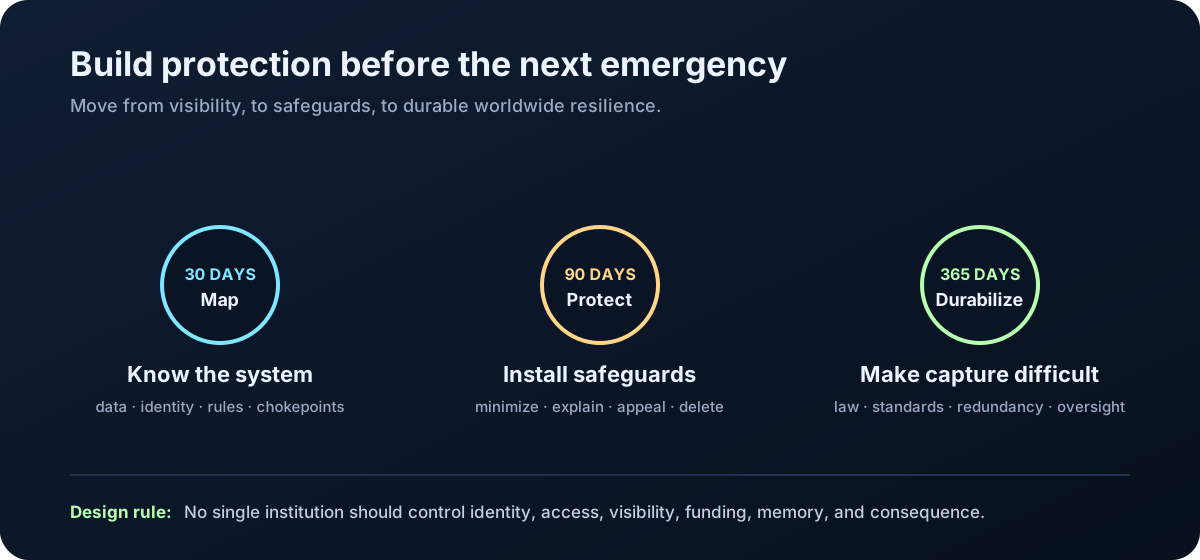
Map identity, data, and chokepoints
- Inventory search, reading, AI conversation, location, biometric, and behavioral records.
- Identify where identity is mandatory and where an anonymous, pseudonymous, or attribute-only option is possible.
- Map who can block access, visibility, payment, hosting, publication, employment, education, or archive custody.
- List every automated judgment that affects a person’s information access or opportunity.
- Record current deletion periods, government-request procedures, appeal routes, and emergency powers.
Install minimum safeguards
- Delete data that is not necessary for a defined function.
- Separate identity, content, safety processing, analytics, and advertising systems.
- Publish understandable rules and notice for consequential decisions.
- Create human review, correction, and appeal with response deadlines.
- Adopt encryption, local processing, short retention, access controls, and immutable audit logs for authorized actions.
Make capture and mission creep difficult
- Enact or adopt enforceable mental-privacy, inquiry-privacy, and neural-data protections.
- Require warrants or equivalent independent authorization for sensitive intellectual records.
- Build provider portability, open standards, interoperable tools, and local alternatives.
- Fund independent journalism, libraries, archives, language access, and public-interest audits.
- Bind exceptional systems to narrow purposes, public evidence, deletion, review, and hard sunsets.
Use implementation kits to assign ownership and proof.
The worldwide action plan identifies common horizons. The implementation-kit programme translates those horizons into bounded threat models, procurement questions, incident procedures, deletion expectations, appeal routes, and measurable outcomes for distinct institutions.
First complete kit: libraries and knowledge institutions
Protect catalog searches, reading and borrowing records, reference questions, public computers, digital lending, archives, and vendor data flows without constructing identity-linked histories of lawful thought.
Twelve commitments that should survive technological change.
Protect inquiry without prejudgment
Lawful questions, reading, research, and private reflection should not become evidence of belief, character, or intent without a separate factual basis.
Publish and share diverse perspectives voluntarily
When a person only needs to prove age, eligibility, uniqueness, or authorization, do not require a reusable identity dossier.
Keep outlying and minority viewpoints discoverable
Collect only what a defined function needs, retain it briefly, prohibit secondary use, and make deletion verifiable.
Audit AI representation and source omissions
Restrict demonstrable harmful acts or narrowly defined capability uplift rather than controversial words, topics, identities, or curiosity.
Demand explainable search rankings and rules
People must be able to understand what is prohibited, how a decision was made, what evidence was used, and what changes the outcome.
Provide correction and appeal for erroneous exclusion
Consequential filtering, removal, profiling, or denial should provide prompt notice, a meaningful human review, correction, and appeal.
Enable pluralistic AI and voluntary contributions
Private communication, local computation, and secure devices should not be converted into universal inspection points.
Keep hyperlinks, publishers and providers plural
No government or company should become an unavoidable gatekeeper for routing, identity, search, AI, hosting, payment, or publication.
Support libraries, independent journalism and research
Independent knowledge institutions need legal protection, confidential sources, sustainable funding, and freedom from political or commercial retaliation.
Preserve multilingual public and dissenting knowledge
Important evidence should exist in multiple formats, languages, institutions, and jurisdictions with provenance and fixity records.
Respect individual disclosure and licensing choices
Exceptional powers should end automatically unless renewed through public evidence and independent review; related data should be deleted.
Measure discovery without prejudging users
Use aggregate, privacy-preserving outcome measures whenever possible. Do not prove success by collecting a population’s intimate intellectual history.
Actions by role
| Role | Start now | Build next | Evidence of progress |
|---|---|---|---|
| Individuals and families | Reduce unnecessary account linkage, review histories, use secure communication, and keep important sources in more than one place. | Develop a personal threat model, recovery plan, trusted contacts, and a habit of checking primary sources and alternative viewpoints. | Fewer persistent records; tested backups; documented privacy settings; accessible help resources. |
| Builders and technology teams | Map sensitive data and stop collecting fields that do not serve a necessary function. | Use local processing, privacy partitioning, short retention, secure deletion, interoperable export, and transparent decision logs. | Data-flow diagrams; deletion tests; external security review; published limitations and appeal metrics. |
| Libraries, schools, and universities | Protect borrowing, search, research, and classroom inquiry from unnecessary observation. | Ban emotion or attention surveillance, restrict vendor reuse, preserve contested materials, and create confidential help routes. | Vendor clauses; retention schedules; challenge records; academic-freedom and privacy audits. |
| Journalists and civil society | Strengthen source protection, document pressure, and preserve exact records with provenance. | Build cross-border partnerships, distributed archives, legal support, multilingual publishing, and transparent correction systems. | Source-safety protocols; replicated archives; public incident and correction ledgers; continuity plans. |
| Governments and regulators | Publish requests, authorities, error rates, procurement, and the evidence supporting restrictions. | Require necessity, proportionality, independent authorization, remedy, deletion, audits, and sunset clauses. | Public statistics; court or independent review; narrowed powers; expired authorities; verified deletion. |
| Funders and institutions | Identify fragile information infrastructure and organizations exposed to financial or political pressure. | Fund open tools, language access, exile media, libraries, independent audits, legal defense, and long-term archive custody. | Multi-year support; diversified providers; geographic redundancy; published governance and conflict safeguards. |
Safety without generalized thought surveillance
A legitimate objective should survive a demanding test before it changes the information environment for everyone.
- Name the harm. Define the event, affected people, probability, severity, and evidence.
- Name the mechanism. Explain how the intervention reduces that harm rather than merely collecting more data.
- Test alternatives. Compare warnings, local controls, targeted investigation, anonymous credentials, private verification, and other less intrusive designs.
- Protect lawful inquiry. Do not treat reading, searching, research, translation, humor, association, or difficult vocabulary as guilt.
- Limit the power. Specify who may use it, for what purpose, with what authorization, for how long, and against which targets.
- Make errors contestable. Provide notice, reasons, evidence preservation, human review, correction, and independent appeal.
- Prove effectiveness. Publish outcome evidence, false-positive costs, disparate impacts, and whether the intervention actually reduced the named harm.
- End it. Delete data, terminate infrastructure that is no longer needed, and require fresh authorization rather than automatic renewal.
Measure outcomes without building dossiers.
Accountability needs evidence, but the measurement system must not reproduce the surveillance problem it is supposed to evaluate.
| Question | Prefer | Avoid |
|---|---|---|
| Did a safety control reduce harm? | Aggregate event rates, sampled audits, independently verified incident trends, and documented false positives. | Permanent identity-linked histories of every lawful query or communication. |
| Is moderation fair? | Policy-level statistics, anonymized appeals, stratified error audits, and published decision categories. | Secret risk labels that follow a person across services. |
| Is a network resilient? | Open measurements, route diversity, failover tests, and service availability by region. | Mandatory inspection of every user’s content. |
| Is an archive trustworthy? | Hashes, provenance, custody logs, replication checks, and transparent corrections. | A single mutable copy controlled by one authority. |
Using the plan
Where should an individual begin?
Begin by asking a lawful question, finding its original sources, comparing a substantive dissenting view and sharing an evidence-labeled perspective through a publisher you choose. Read the thought-diversity research to see how to challenge a measurable omission. Personal privacy remains available when you want it.
What should an organization do first?
Map what the organization crawls, indexes, ranks, trains on, cites and excludes. Publish source and correction policies, test language and viewpoint coverage, link openly to external evidence, and provide meaningful review of erroneous exclusions. Respect voluntary contribution terms.
Does this plan reject safety controls?
No. It requires evidence of a specific harm, a measurable objective, the least intrusive effective design, protection of lawful inquiry, independent review, and an end condition.
Can one country implement the whole solution?
No. Rights, infrastructure, archives, standards, journalism, and technical interoperability cross borders. Durable protection requires local action plus international cooperation and distributed custody.