
Freedom begins before speech
Your mind is your own.
Your questions should be, too.
Cognitive liberty protects the private space where people think, search, read, compare, doubt, imagine, dissent, and change their minds—without turning lawful inquiry into a permanent judgment about who they are.
- 74
- exact research reports preserved in protected custody
- 5
- complete implementation kits for real institutions
- 0
- trackers, adtech, or third-party runtime requests
What cognitive liberty protects
The freedom to form a thought before anyone decides what it means about you.
The worldwide pattern
Different countries. Different laws. The same dangerous convergence.
Mandatory identity can make inquiry traceable. Network centralization can make access controllable. Intermediary liability can privatize censorship. Search and AI can silently rank, infer, refuse, and rewrite. Commercial vendors can export the machinery. The danger is not one nation; it is a reusable architecture spreading across borders.
Identity before access
Real-name, biometric, age, and account systems can connect lawful questions across contexts long after the original purpose ends.
The layered censorship stack
Law, infrastructure, platforms, finance, surveillance, and AI can reinforce one another without a single visible censor.
Resistance and resilience
Encryption, decentralization, independent media, archives, diaspora networks, and social trust keep knowledge alive.
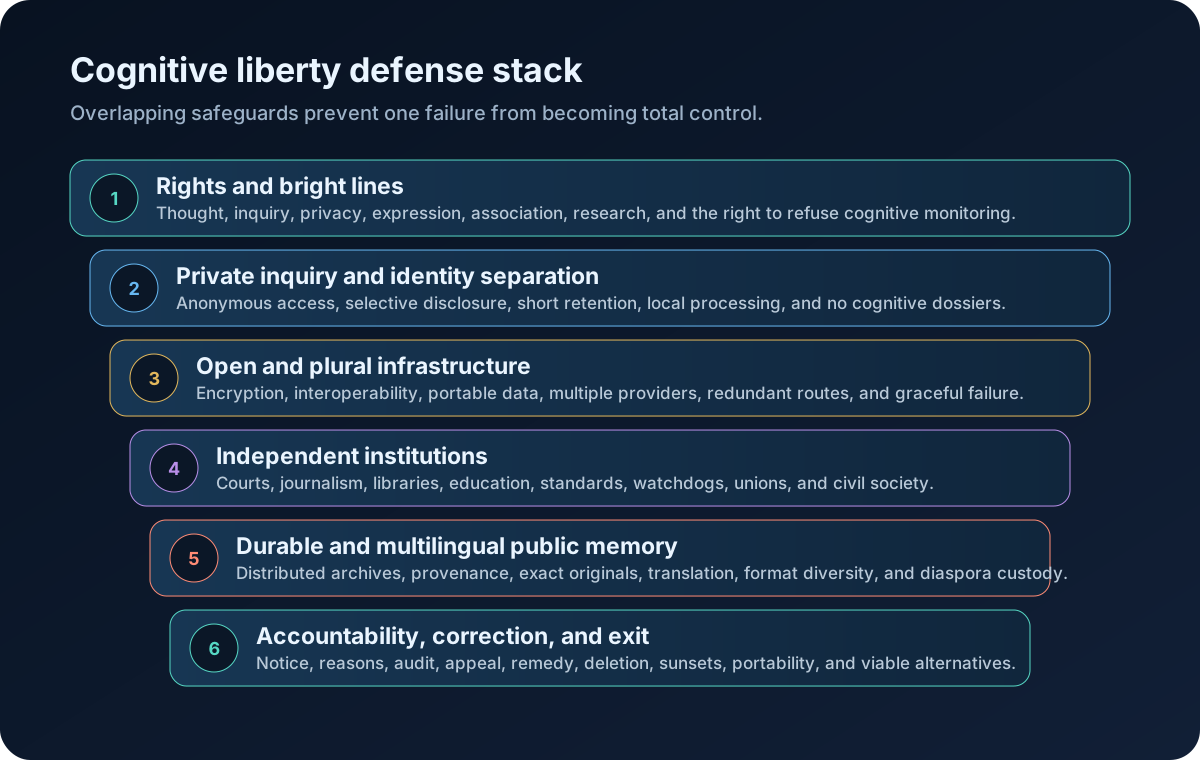
A defense stack for the whole system
Do not wait for one chokepoint to become a complete control architecture.
Rights, privacy, encryption, open infrastructure, independent journalism, education, multilingual archives, algorithmic audits, due process, and hard sunsets must reinforce one another. The resilience framework turns the expanded 74-report source corpus into a practical worldwide design while preserving a separate evidence status for every public claim.
The trend is measurable
Worldwide pressure is rising—and independent measurement makes it visible.
These figures are dated snapshots, not permanent country labels. Together they show why cognitive liberty needs cross-border safeguards, independent research, and institutions capable of correcting overreach.
countries with declining freedom of expression
V-Dem reports deterioration in 2025 compared with 2015, while only 11 countries improved.
V-Dem Democracy Report 2026of consecutive decline in internet freedom
Freedom House found conditions worsened in 28 of 72 assessed countries during its 2025 coverage period; 17 improved.
Freedom on the Net 2025documented internet shutdowns in 2025
Access Now and the #KeepItOn coalition recorded deliberate shutdowns across 52 countries.
#KeepItOn 2025 findingsopen censorship measurements
OONI reports more than three billion measurements from 30 thousand networks across 245 countries and territories since 2012.
OONI global measurement datasetEvidence snapshot: reports published or current through 2 September 2026. Methodologies, coverage, and uncertainty differ by source.
A worldwide research and defense network
Cognitive liberty is bigger than one site, one country, or one discipline.
The new ecosystem research maps organizations, researchers, standards, libraries, privacy engineers, neurorights institutes, digital-rights groups, open technology, and ethical collaboration pathways. The goal is to connect useful work—not manufacture endorsements or search-engine signals.
Libraries, human-rights bodies, digital-rights groups, neurorights organizations, standards bodies, and research centers defend different layers of the same freedom.
Oblivious transport, selective disclosure, encryption, private retrieval, and data-minimization standards can make non-surveillance a system property.
The academic network includes both advocates for new neurorights and scholars who favor stronger use of existing freedom-of-thought, privacy, and integrity doctrine.
Local AI, anonymous networking, reproducible software, decentralized archives, and open protocols reduce dependence on a single knowledge gatekeeper.
The defining civil-liberties question
Who controls the space where thought forms?
Search engines interpret intent. AI assistants retain context and decide what to answer. Recommendation systems shape attention. Data brokers infer hidden traits. Employers and schools can turn behavior into scores. Neurotechnology can make nervous-system signals machine-readable. These systems can expand human freedom—or quietly govern it.
Queries are thought data
A question can reveal uncertainty or curiosity without proving belief, character, or intent. Search privacy protects the process of becoming informed.
Systems infer who is asking
Intent, context, safety, age, location, and personalization can improve relevance while creating hidden profiles and false judgments.
Systems also judge publishers
Ranking and AI source selection determine which ideas reach the public—and which lawful perspectives become effectively invisible.
The expanded control surface
Censorship can begin long before a page is blocked.
The new research follows information through its full life cycle: who is allowed to read privately, which data trains AI, what a recommender makes visible, how education and translation shape meaning, whether journalism can be funded, what war does to secrecy, and whether archives and networks can survive a hostile gatekeeper.
A different reality for each user
Personalization can quietly vary sources, framing, refusals, and visibility according to an inferred profile.
Control before the model answers
Dataset selection, deduplication, policy filtering, and language imbalance decide what knowledge survives upstream.
The right to read without being judged
Reading and search records reveal unfinished thought and should not become permanent character evidence.
Private conversation as civic infrastructure
Confidential dialogue lets people test ideas, seek help, organize, and change their minds without an audience.
Preserve evidence across failures
Fixity, replication, distributed custody, provenance, and lawful access keep vulnerable records from disappearing.
Build an internet with practical exit
Open protocols, provider choice, portability, encryption, and graceful failure reduce capture by one authority.
The safety poison pill
Safety must not become a shortcut to cognitive control.
A real harm does not automatically justify universal identity, permanent query logs, behavioral risk scoring, secret classifiers, client-side scanning, or broad suppression of lawful inquiry. The test is worldwide and institutional: is the intervention specific, necessary, effective, proportionate, contestable, privacy-preserving, and designed to end?
Define the harmName the event, evidence, probability, severity, and affected population.
Target conduct or capabilityDo not turn curiosity, reading, or controversial vocabulary into a presumption of guilt.
Use the least intrusive designPrefer warnings, local controls, anonymous credentials, short retention, and targeted process.
Prevent the ratchetRequire deletion, purpose limits, public statistics, independent review, and hard sunsets.
A seventy-four-report research programme
Evidence and strategy for a worldwide fight.
The research programme now combines 48 public guides with 26 exact report-only research artifacts covering global history, legal standards, intellectual freedom, neurorights, private reading and conversation, AI governance, privacy standards, academic networks, open technology, censorship industries, archival resilience, and practical defense.
Why cognitive liberty matters
Why private thought formation is upstream from speech, association, religion, science, culture, and self-government.
Global history of censorship
Recurring structures of control and resistance across eras, regions, institutions, and technologies.
AI regulation and censorship risk
How licensing, logging, provenance, identity, and filtering can become a global control layer.
An uncensored internet architecture
Open protocols, encrypted metadata, plural providers, portable identity, resilient routes, and graceful failure.
Censorship-resistant archives
How exact files, provenance, replication, multilingual custody, and distributed institutions preserve evidence.
How to fight back
A lawful, nonviolent strategy across legislation, courts, standards, technology, libraries, workplaces, and civil society.
The liberty-first doctrine
Safety should target demonstrable harmful conduct or narrowly defined capability without turning lawful thought, private curiosity, reading, searching, research, memory, or identity into objects of generalized surveillance and control.CognitiveLiberties.com editorial doctrine