The right to hear and be heard. Ask freely. Share your perspective. Explore disagreement. Read our mission →
Architectures for liberty
Safety does not require watching everyone.
Many legitimate protections can be delivered without building a centralized history of what people search, read, ask, or communicate. The design goal is to separate the safety function from identity and long-term memory.
Editorial research synthesisInfrastructure, journalism, and resilienceWorldwide principles with selected jurisdictional examplesUpdated 2026-10-12
Direct answer
Safety without surveillance is technically possible when systems minimize data, process sensitive content locally, separate identity from request content, query threat databases privately, aggregate only anonymous statistics, and prove attributes such as age without revealing full identity. These architectures cannot solve every safety problem, but they show that persistent inquiry logs are often a business or investigative choice rather than a technical necessity.
Key points
On-device processing can classify or sanitize content without sending raw private material to a central server.
Oblivious HTTP separates the party that sees the user’s network identity from the party that processes the request.
Private Information Retrieval lets a client query a database without revealing which record it requested.
Distributed aggregation and differential privacy can measure system-wide abuse without exposing individual reports.
Anonymous credentials can prove an attribute—such as age eligibility—without disclosing a complete identity.
Change the architecture, not the promise
A privacy policy can promise that data will not be misused, but a retained database remains available to insiders, attackers, future owners, subpoenas, and changed policies. A stronger design does not collect the identifying data in the first place or separates it so no single party can reconstruct the whole interaction.
This is the difference between institutional restraint and technical restraint. Both matter, but the latter reduces the number of future decisions that can go wrong.
Five privacy-preserving building blocks
Privacy-enhancing technologies for safety functions
Tool
What it protects
Example safety use
On-device models
Raw prompts, messages, images, and behavioral data
Local content classification or PII redaction
Oblivious HTTP
Links between IP identity and request content
Malicious-site checks without exposing browsing history
Private Information Retrieval
The specific record requested from a database
Private lookup of a URL or file hash in a threat list
Distributed aggregation + differential privacy
Individual telemetry and rare-event identification
Measure abuse trends without collecting per-user histories
Anonymous credentials
Identity beyond the required attribute
Prove “adult” or “human” without revealing name or birthday
Two concrete patterns
Private threat intelligence
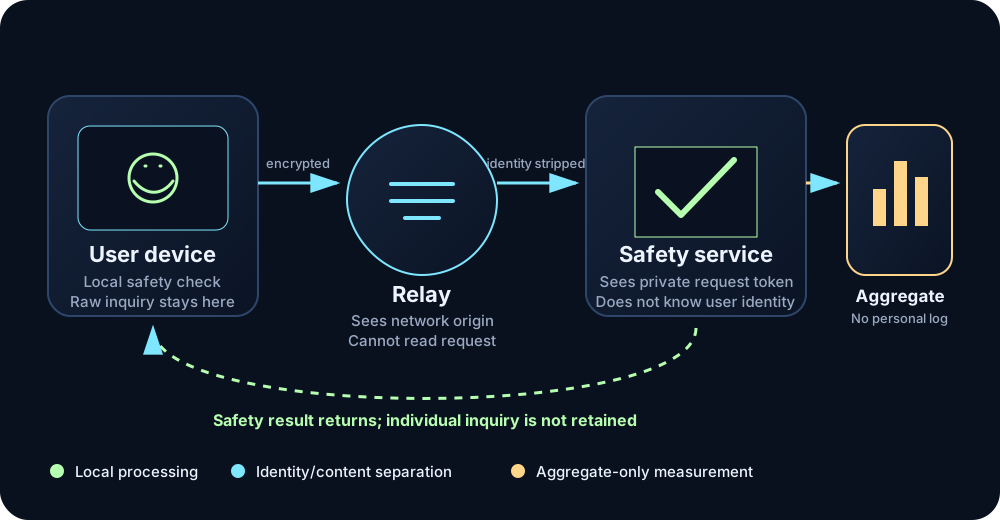
A browser hashes a URL, prepares a private lookup, and sends it through an oblivious relay. The threat provider can answer whether the resource is known to be dangerous without learning both the user’s identity and the exact browsing request.
Aggregate abuse measurement
A local classifier identifies a safety category on the device. Instead of uploading the content, the device secret-shares a minimal event count across independent aggregators. The service learns that a category is increasing across the population but cannot reconstruct an individual person’s message.
A liberty-preserving safety architecture separates identity, content, and aggregate measurement.
Trade-offs and limits
Privacy-preserving systems introduce costs. Relays add latency. Private database queries require additional computation. Local models consume battery and may perform worse on older devices. Multi-party systems depend on non-collusion or cryptographic assumptions. Differential privacy can reduce precision, especially for rare events.
Those costs should be compared with the security cost of centralized data: breaches, insider access, government overreach, and function creep. The proper question is not whether privacy has zero cost. It is whether retaining a complete cognitive history is necessary for the safety outcome.
Design rule: If the same safety result can be achieved without retaining a person’s inquiry history, the system should not retain that history.